Extended Data Services Overview
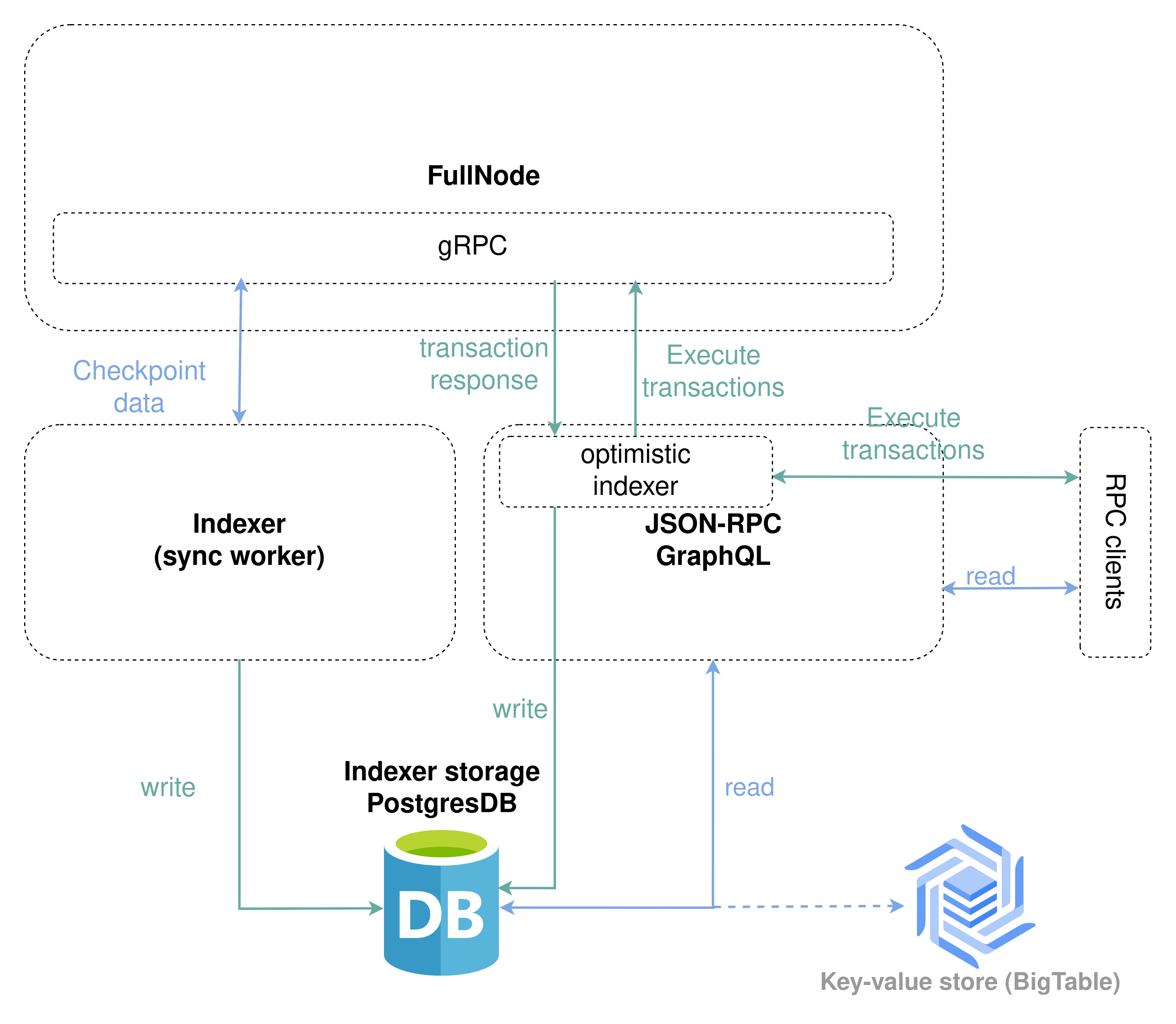
The IOTA Indexer is an off-chain service that makes IOTA network data easy to query. It ingests data from an IOTA node, stores it in a PostgreSQL database, and serves it through query APIs JSON-RPC and GraphQL.
Functions
The IOTA Indexer provides three main functionalities:
- Ingest data from a full node to a relational database. Data on full nodes is stored as BCS bytes in an embedded RocksDB database, thus the query capabilities are very limited. The indexer pulls checkpoint blob data, schematizing them into various tables like objects, transactions, and so on, with proper indices.
If the full node does not retain its historical data, the indexer can be configured to ingest from a hybrid historical checkpoint store instead. This combines two sources:
- A historical checkpoint store with the full archive from genesis to the network tip.
- An optional live checkpoint store storing only current-epoch checkpoints, used for real-time ingestion.
iota-indexer \
  --db-url <DATABASE_URL> \
  indexer \
  --remote-store-url https://checkpoints.<NETWORK>.iota.cafe/ingestion/historical \
  --live-checkpoints-store-url https://checkpoints.<NETWORK>.iota.cafe/ingestion/live
For more info see the reference table.
- Serve online transaction processing (OLTP) RPC requests. With data in relational databases, IOTA indexer spins a stateless reader binary as JSON RPC server with the associated interface.
- Other than OLTP data ingestion and requests, the Indexer also supports some analytical data ingestion like transactions per second (TPS) and daily active user (DAU) metrics.
One Indexer instance can provide one of the above mentioned functionalities. They can be enabled with the corresponding subcommands in the Indexer CLI like:
indexerjson-rpc-serviceanalytical-worker
Most RPC calls mentioned in interface will only work with an indexer running. This is always mentioned in the RPC call description if it is the case. Indexer RPC calls that provide metrics are provided by the analytical worker.
Run an Indexer
- IOTA Indexer — ingest checkpoint data into a local or managed Postgres-compatible database, with optional pruning to control storage growth.
- IOTA Indexer JSON-RPC — serve online transaction processing (OLTP) RPC requests against the indexed data.
Run GraphQL Interface
Alternatively to the JSON-RPC, a GraphQL interface can be used to provide read access to the Indexer database, and enable execution of transactions to the full node.
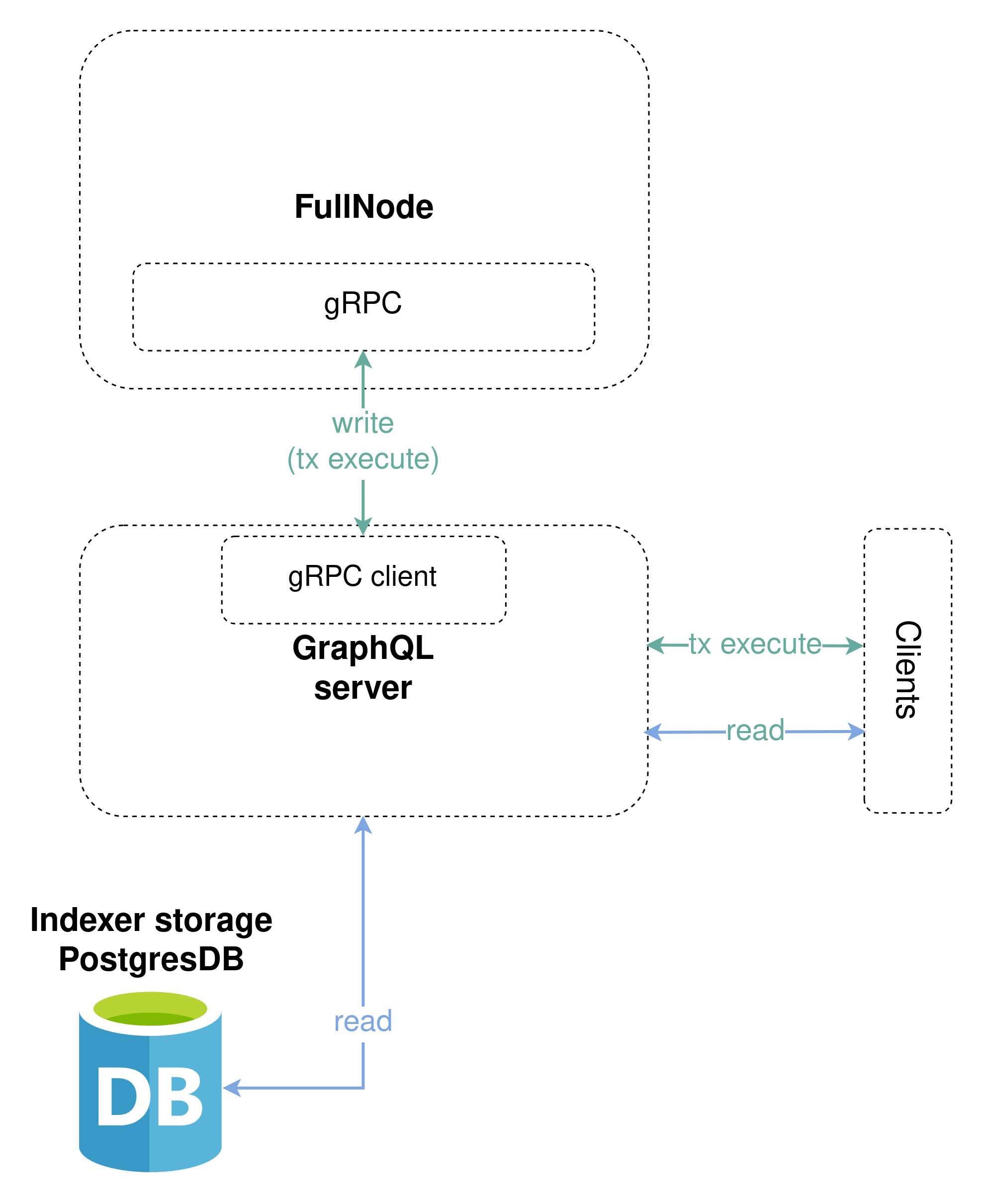
A running Indexer database instance is required for the GraphQL API to be functional, so it is advised that an Indexer sync worker is setup and started first.
For more information, see GraphQL.